How Michelin-Starred Restaurants in London Use Social Media to Find New Audiences Without Losing Prestige
Michelin stars still signal excellence, but they're no longer enough to guarantee visibility. Today's affluent diners discover restaurants through TikTok, Instagram, and social content long before they read reviews or consult guides. This article explores how Michelin-starred restaurants in London can balance prestige with discoverability, using social media to showcase craftsmanship, build trust, and attract a new generation of high-spending diners without compromising their brand positioning.

Michelin stars still open doors. But they no longer guarantee a full dining room.
The way affluent diners, particularly those under 40, discover restaurants has shifted decisively. They are not reading critic columns first or waiting for a Sunday supplement recommendation. They are scrolling TikTok at midnight, saving Instagram Reels to a shared list with friends, and treating social platforms as their primary dining search engine. According to Lumina Intelligence, quality-led decision-making now drives nearly 80% of eating-out occasions in the UK, but the decision itself increasingly starts on social media, not in a review.
This creates a genuine strategic challenge for Michelin-starred restaurants in London. The prestige of an award is not in question. The discoverability of the restaurant that holds it absolutely is.
The core tension: Fine dining has built its identity on restraint, exclusivity, and earned reputation. Social media rewards frequency, personality, and entertainment. The restaurants navigating this tension well are not compromising their standards. They are translating them into a format a new generation of high-spending diners can actually find.
This article breaks down how London's top-tier restaurants are using social media to reach new audiences, which platforms are doing the real work, and what practical steps any Michelin-listed operator can take to build discoverability without diluting what makes them exceptional.
The Attention Economy Has Reached Fine Dining
For most of fine dining's history, reputation travelled slowly and deliberately. A Michelin star was announced. Critics wrote. Word spread through the right circles. Bookings followed over months, sometimes years. That cycle still exists, but it now runs in parallel with a much faster one.
Social media and review platforms now account for over half of all guest discovery and initial contact in the UK hospitality sector. A separate figure from hospitality trade data puts it more precisely: 68% of guest-initiated contact with restaurants now begins on social or review platforms. The phone call and the walk-in have been replaced by a saved Instagram post and a TikTok search.
The demographic shift driving this is not subtle. Under-40 diners, many of whom represent the next generation of high-frequency, high-spend restaurant customers, are using TikTok and Instagram as their primary discovery tools for dining. These are not casual diners. Lumina Intelligence data shows that average spend per eating-out visit reached £18.35 in Q1 2026, up 5.5% year-on-year, and that people are going out less often but spending more deliberately per occasion.
"People go out less often, but have better experiences, with visits becoming more purpose-led and budget-aware rather than casual or habitual." — Lumina Intelligence, 2026
This matters enormously for Michelin-starred restaurants. The diner who books a table at a two-star restaurant in London is not making an impulsive decision. They are researching. They are comparing. And increasingly, the first impression they form of a restaurant happens on a phone screen, weeks before they ever arrive.
The restaurants that understand this are not abandoning their identity. They are creating a social presence that earns the same trust their dining room does.
Instagram vs TikTok: Two Different Jobs to Do
The most common mistake premium restaurants make on social media is treating Instagram and TikTok as interchangeable channels that simply require different aspect ratios. They are not. Each platform performs a distinct function in the path from discovery to booking, and conflating them produces content that underperforms on both.
Instagram: The Digital Front of House
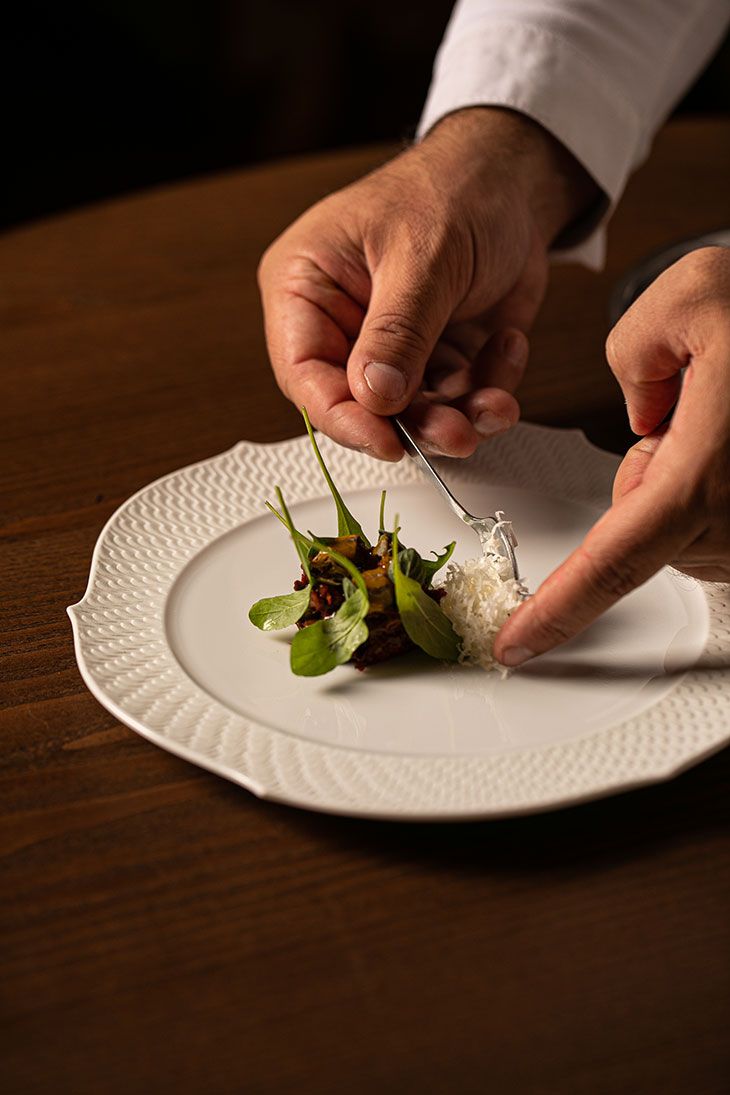
Instagram functions as a restaurant's digital shop window and trust-building tool. Its audience skews slightly older and tends toward higher average spend. For Michelin-starred restaurants, it is where considered, high-quality imagery of plating, interiors, and seasonal menus reinforces the credibility that a star signals. A well-curated Instagram grid tells a prospective diner: this place is exactly what you are hoping for.
The Michelin Guide itself has noted that starred restaurants are increasingly treating Instagram as a primary "front of house" channel, with many updating their bios to prominently feature their star status immediately following an award announcement. The visual language of fine dining, precise plating, handwritten menus, the theatre of tableside service, translates naturally into the aesthetic Instagram rewards.
What works on Instagram for fine dining:
- High-resolution dish photography with strong natural or directional light
- Short Reels (15 to 30 seconds) showing plating technique or kitchen preparation
- Seasonal menu announcements paired with visual storytelling
- Behind-the-scenes content featuring the head chef or front-of-house team
- Stories used for real-time updates: today's specials, availability, events
TikTok: The Discovery Engine
TikTok operates differently. It is an algorithm-driven discovery platform where content reaches users who have no prior relationship with the restaurant, and where a single video can drive weeks of booking demand. The Michelin Guide's own social guidance highlights that 5 to 12 second cuts perform best for engagement on TikTok, a format that rewards immediacy and visual impact over polish.
Critically, TikTok is now being used as a search engine. Younger diners type "best tasting menu London" or "Michelin restaurant London date night" directly into TikTok's search bar, bypassing Google entirely. Restaurants with a presence on the platform appear in those results. Restaurants without one do not.
What works on TikTok for fine dining:
- Dish theatre: the moment a sauce is poured, a dome is lifted, a flame appears
- Short chef commentary: technique explained in 15 seconds, no script needed
- "What we ate at [restaurant name]" style content, ideally from real diners or invited creators
- Kitchen process videos that show the craft behind a signature dish
- Reaction-style content that captures a diner's genuine first response
The key distinction is intent. Someone saving an Instagram post is filing it away for a future booking. Someone watching a TikTok about a restaurant is discovering it for the first time. Both matter. But they require different content strategies, different posting cadences, and different definitions of success.
What Socially Native Restaurants Do Differently
There is a useful comparison to be made between London restaurants that were born with a social media identity and those that earned their Michelin stars before Instagram existed. The former group treats content as part of the product experience. The latter often treats it as an afterthought, or worse, as a risk to be managed.
The gap in attention is measurable. Socially native restaurants in London, many of which have no formal culinary awards, regularly generate tens of thousands of views per post, drive waiting lists through organic reach alone, and command booking demand that outpaces their physical capacity. They do this not because they have better food, but because they have made discoverability a deliberate part of their operation.
The lesson for Michelin-starred restaurants is not to copy this approach wholesale. It is to understand what drives it and apply those principles with appropriate restraint.
The Four Behaviours That Separate High-Performing Restaurant Accounts
- Behaviour: Posting frequency — Socially Native Restaurants: 4 to 7 times per week across platforms — Traditional Fine Dining: 1 to 2 times per week, often inconsistent
- Behaviour: Content type — Socially Native Restaurants: Process, personality, and theatre — Traditional Fine Dining: Finished dishes and formal announcements
- Behaviour: Chef visibility — Socially Native Restaurants: Chef is a recurring on-camera presence — Traditional Fine Dining: Chef rarely appears in content
- Behaviour: Response to virality — Socially Native Restaurants: Actively encourages and amplifies UGC — Traditional Fine Dining: Rarely engages with or reposts guest content
Each of these behaviours is addressable without compromising the standards or tone of a Michelin-level operation.
Frequency matters more than perfection. The algorithm on both Instagram and TikTok rewards consistency. A restaurant posting three to four times per week with varied content will consistently outperform one posting a single polished image every ten days, regardless of how beautiful that image is. The shift required is operational: building a content production habit, not a content production event.
The chef is the story. In casual dining, the chef is often invisible. In fine dining, the chef is the entire narrative. A 20-second video of a head chef explaining why they source a specific ingredient, or demonstrating a knife technique, performs exceptionally well on both platforms because it does something a photograph cannot: it builds a relationship. Diners who feel they know a chef are significantly more likely to book and significantly more likely to return.
User-generated content is social proof at scale. When a guest films their dish and posts it, that content reaches their entire network with implicit endorsement. Restaurants that actively encourage this, through thoughtful plating moments designed to be filmed, by acknowledging and reposting guest content, by creating experiences worth sharing, effectively multiply their content output without any additional production cost. This is not a compromise of exclusivity. It is an extension of word-of-mouth into a digital format.
A Practical Social Media Playbook for Michelin-Listed Restaurants
Strategy is only useful when it becomes action. The following framework is built around what consistently works for premium hospitality brands on social, adapted for the specific constraints and opportunities of Michelin-level operations in London.
Content Pillars: What to Post and Why
Rather than approaching each post as a standalone decision, high-performing restaurant accounts operate from a small set of recurring content pillars. This creates consistency for the audience and simplifies production decisions for the team.
1. Craft and Process Show the work behind the food. Sourcing trips, prep techniques, the moment a dish is finished on the pass. This content performs because it is genuinely interesting and because it signals quality in a way a finished plate cannot. It answers the question diners are already asking: why does this restaurant deserve a star?
2. Dish Theatre Every tasting menu has at least one moment designed to surprise or delight the guest at the table. That moment should also exist on social. A sauce poured tableside, a dish revealed under glass, a dessert that changes colour. These are inherently shareable, require no scripting, and generate organic reach when guests film them independently.
3. The People Behind the Restaurant The head chef, the sommelier, the front-of-house team. Brief, unscripted appearances build familiarity and personality. These do not need to be produced. A 15-second clip of a chef explaining today's fish, filmed on a phone in the kitchen, consistently outperforms a studio-quality photograph of the same dish.
4. Seasonal and Event-Led Content Menu changes, special collaborations, private dining events, and award announcements. These are natural content moments that align with genuine news. They also serve a booking function: a seasonal menu launch posted with a link to reservations is both content and conversion.
Influencer and Creator Strategy
Inviting food creators to the restaurant is now a standard practice across London's hospitality scene, but the approach taken by premium operators differs significantly from the casual dining model.
For Michelin-starred restaurants, the right creator is not necessarily the one with the largest following. The relevant metrics are audience quality, content tone, and alignment with the restaurant's positioning. A creator with 40,000 highly engaged followers who consistently covers fine dining and cultural experiences in London will deliver more qualified bookings than a generalist food influencer with 400,000 followers and a broad, undifferentiated audience.
The briefing process matters too. Creators invited to a premium restaurant should be given context, the story behind the menu, the sourcing philosophy, the significance of a particular technique, so their content reflects the depth of the experience rather than just the visual spectacle of it.
Turning Social Presence Into Bookings
Social media reach is only commercially valuable if it converts to reservations. The connection between the two is often weaker than it should be, not because the content is poor, but because the path from content to booking is not clear enough.
- Every post that features a specific menu or experience should include a direct link to the reservations page, either in the caption or in the bio link.
- Instagram Stories are particularly effective for time-sensitive booking prompts: limited availability for a specific date, a new tasting menu launching next week, a cancellation that has just appeared.
- TikTok's link-in-bio function, combined with a pinned post directing viewers to book, creates a discoverable booking pathway for new audiences who find the restaurant through organic content.
The key principle: social media builds desire. The reservation system captures it. The gap between the two should be as small as possible.
Prestige and Discoverability Are Not in Conflict
The fear that social media will cheapen a Michelin-starred restaurant's identity is understandable, but it is based on a false premise. Prestige is not diminished by being seen. It is diminished by being invisible.
The restaurants winning on social media in London are not doing so by abandoning what makes them exceptional. They are doing so by finding ways to communicate that exceptionalism in a format that younger, affluent diners actually encounter. The craft, the sourcing, the technique, the story of a dish: these are compelling precisely because they are genuine. Social media does not require restaurants to manufacture a personality. It requires them to share the one they already have.
The practical gap for most Michelin-listed operators is not ambition. It is resource, consistency, and the operational infrastructure to produce content at the frequency modern platforms require. That is a solvable problem, and it is one that a growing number of London's most celebrated restaurants are actively solving.
The bottom line: Attention now sits upstream of reputation. Earning a Michelin star is still the goal. Making sure the right diners can find you before the critics do is the new competitive advantage.
If you are looking to build a social media strategy that reflects the quality of your restaurant without compromising your positioning, 303 works with premium and luxury brands across London on exactly this kind of challenge.